
Professional Sports Betting: Is It a Realistic Career Path?
Ever felt like sports betting is a rollercoaster of hope and disappointment? You’re not alone. The truth is, consistently winning isn’t about lucky jerseys or gut feelings. It’s about mastering probability. Imagine turning those confusing odds into a clear advantage. That’s the power of understanding probability in sports betting.
This isn’t your typical “trust your instincts” guide. We’re diving deep into the science behind successful betting. Forget hunches; we’re talking calculated risks, informed decisions, and a strategic approach that puts you in control. From decoding odds to identifying value bets, we’ll equip you with the knowledge to transform your betting game.
Consider this your crash course in probability for sports betting. We’ll break down complex concepts into easy-to-understand strategies, giving you actionable tips you can use right away. Get ready to ditch the guesswork and embrace a smarter, more profitable way to bet.
Understanding the Foundation: Probability and Odds
Before diving into the exciting world of sports betting, it’s crucial to build a solid understanding of probability and odds. These concepts are the bedrock upon which all betting strategies are built. Probability, in its simplest form, represents the likelihood of a specific event occurring. It’s a number between 0 and 1, where 0 means the event is impossible, and 1 means the event is certain. You can also express probability as a percentage, ranging from 0% to 100%.
Odds, on the other hand, are a way of representing the ratio between the probability of an event happening and the probability of it not happening. They come in several forms, each with its own way of conveying potential payouts. The three most common types of odds are fractional, decimal, and moneyline.
Fractional odds (e.g., 5/1) express the profit you’d make relative to your stake. So, a 5/1 fractional odd means that for every $1 you wager, you’ll win $5 in profit, plus your original $1 stake back. Decimal odds (e.g., 6.0) represent the total payout you’d receive for every $1 wagered, including your stake. Therefore, an easy calculation can be made using decimal odds, the stake multiplies the betting odds to find out the potential return. Finally, moneyline odds (e.g., +500 or -500) are most commonly used in the United States. A plus sign (+) indicates the amount you would win on a $100 wager, while a minus sign (-) indicates the amount you need to wager to win $100. Knowing how to convert between these different types of odds is a handy skill for comparing offers from different sportsbooks and finding the best value for your bets. It allows you to quickly assess the potential return on investment, no matter how the odds are presented. Without understanding how probability and odds work, sports betting is nothing more than gambling.

Decoding the Odds: Implied Probability and Fair Value
Ever felt like deciphering betting odds requires a secret decoder ring? Understanding implied probability is your first step toward becoming a sharper, more strategic bettor. Essentially, implied probability reveals the bookmaker’s perceived likelihood of a particular outcome. Once you grasp this concept, you can start spotting opportunities to identify value bets – situations where the odds offered are higher than your own estimated probability of that outcome occurring.
So, how do you crack the code? The method depends on the odds format presented. For decimal odds, the calculation is straightforward: Implied Probability = 1 / Decimal Odds. For example, decimal odds of 2.0 translate to an implied probability of 50%. When dealing with fractional odds (e.g., 1/1), convert them to decimal odds first (1/1 = 2.0), then apply the same formula. American odds require a bit more finesse. If the odds are positive (e.g., +200), Implied Probability = 100 / (Odds + 100). If the odds are negative (e.g., -150), Implied Probability = Odds / (Odds + 100).
Now comes the savvy part: comparing the implied probability to your own assessment. Let’s say you’re eyeing a soccer match. The bookmaker offers decimal odds of 3.0 on Team A winning, implying a 33.3% probability. However, after analyzing team form, injuries, and head-to-head records, you believe Team A has a 45% chance of winning. This discrepancy signals a potential value bet. The bookmaker’s odds are offering a higher payout than you think they should, given Team A’s actual chances. Hunting for value is not gambling; it’s educated guessing!
The Bookmaker’s Perspective: How Odds are Set
Delving into the mechanics of odds setting unveils the intricate strategies employed by bookmakers. It’s more than just guesswork; it’s a calculated blend of data analysis, psychological insight, and risk management.
Bookmakers, or sportsbooks, meticulously assess a range of factors before posting their initial odds. Historical data serves as a cornerstone, providing a baseline understanding of team performance and head-to-head records. Sophisticated statistical models then come into play, projecting potential outcomes based on various inputs. These aren’t simple algorithms; expert systems crunch vast datasets to identify subtle advantages and predict likely scenarios.
However, quantitative analysis is only part of the equation. Real-time information, such as team news, player injuries, and even weather conditions, can significantly influence the odds. A star player’s sudden absence or an unexpected downpour can shift the perceived probability of a particular outcome.
Public perception also plays a crucial role. Bookmakers monitor betting trends, recognizing that heavy public backing can distort the odds, creating opportunities for informed bettors. These ‘market movers’ trigger line adjustments, as bookmakers aim to balance their books and minimize their own risk. The ultimate goal to maintain profit, regardless of the game’s outcome. Understanding these influences provides a unique perspective on the betting landscape.
Identifying and Exploiting Biases
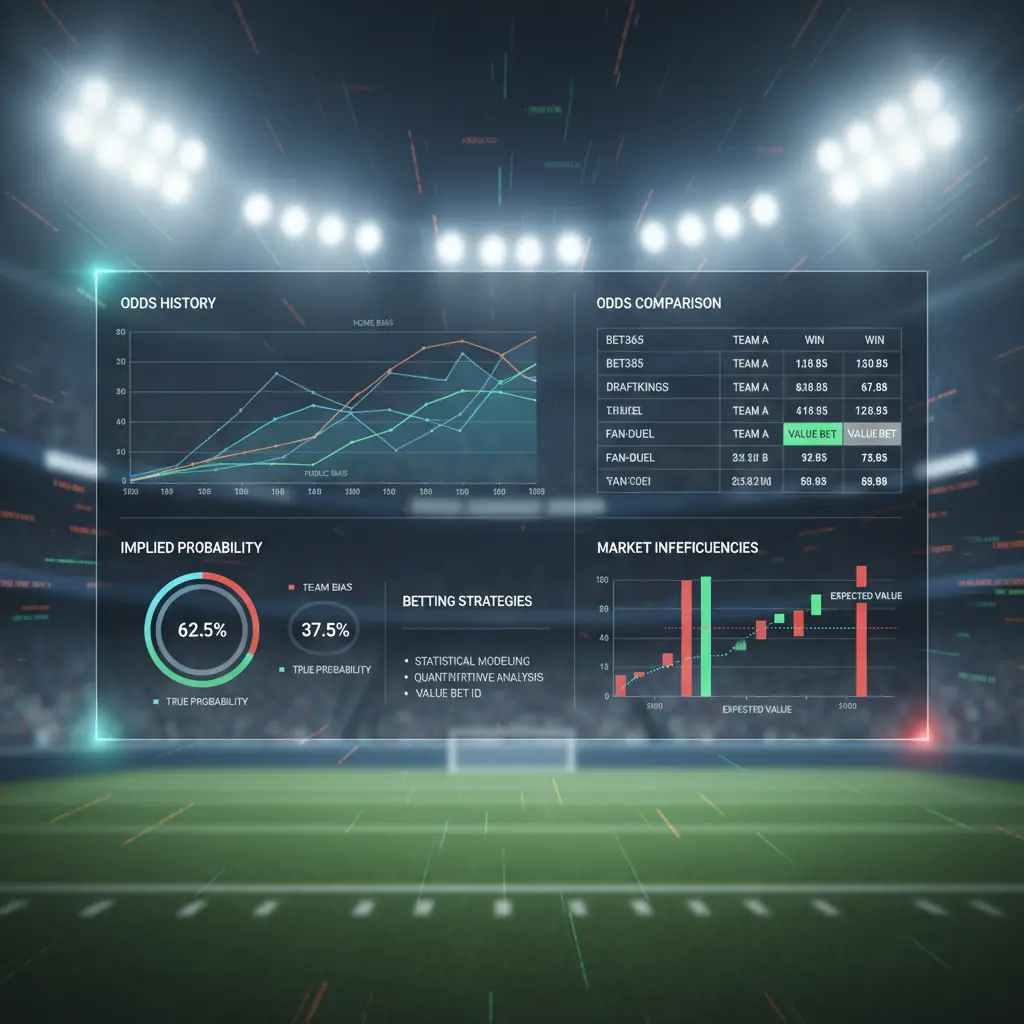
Sports betting markets, while seemingly efficient, are rife with biases. These biases, stemming from human psychology and the way information is processed, can lead to skewed odds and create opportunities for savvy bettors. Recognizing and exploiting these market inefficiencies is a crucial skill for anyone looking to gain an edge.
One of the most prevalent biases is the public bias. This occurs when a large segment of the betting public wagers on a particular team or outcome, often based on popularity, emotional attachment, or recency bias (overweighing recent events). For instance, a wildly popular team like the Yankees might consistently draw heavy betting action, even if the odds don’t accurately reflect their true chances of winning. Bookmakers, aware of this tendency, might shorten the odds on the Yankees, creating value on the opposing side. Spotting discrepancies between public perception and true probabilities is key here.
Another common bias is home bias. Teams generally perform better at home, this is a fact, and this advantage gets amplified in the eyes of bettors. The perceived home-field advantage can be overstated, leading to inflated odds on the home team. Similarly, favorites bias sees bettors disproportionately backing the perceived stronger team, while underdog bias, though less common, can occur when a plucky underdog captures the public’s imagination.
Identifying these biases isn’t always straightforward. Bookmakers are sophisticated and constantly adjusting their lines to account for public sentiment and other factors. Furthermore, what appears to be a bias might simply be a well-informed assessment of the game. It requires a deep understanding of the sport, statistical analysis, and a good dose of skepticism to differentiate genuine opportunities from mirages. The trick is to find situations where the odds deviate significantly from your own assessment of the probable outcome, factoring in all available information and consciously guarding against your own biases. This all creates vulnerabilities to be exploited but don’t expect it to be easy.
Advanced Concepts: Expected Value, Variance, and Bankroll Management
Aspiring to thrive in the world of calculated risks? It demands more than just picking winners; it requires a grasp of advanced concepts that separate the seasoned pros from the casual players. Mastering expected value, understanding variance, and practicing meticulous bankroll management are the cornerstones of long-term profitability.
Expected Value (EV): The Core of Profitable Betting
Expected Value (EV) is the average profit or loss you can anticipate from a bet if you were to repeat it numerous times. It’s the compass guiding you toward +EV (positive expected value) scenarios, where the odds are in your favor. Calculating EV involves considering the probability of each outcome and the associated payout. For example, imagine a coin flip where you bet $10 on heads. If heads pays out $21 (including your stake), and the probability of heads is 50%, the EV calculation is: (0.5 $11) – (0.5 $10) = $0.5. This indicates a positive expected value of $0.50 per flip.
Variance: Navigating the Rollercoaster
Variance, the inevitable ups and downs that define the betting experience, can lead to winning streaks that inflate your ego and losing streaks that test your resolve. Skilled bettors understand that variance is not a reflection of their skill but a statistical reality. Even with a positive EV strategy, short-term results can deviate significantly from the expected outcome. Imagine a poker player that has the best hand most of the time but sometimes loose because the other players get lucky draws. That is the variance.
Bankroll Management: Your Financial Foundation
Effective bankroll management is the bedrock of sustainable betting. It’s about protecting your capital and ensuring you can weather the storm of variance. A common guideline is to risk only 1-5% of your bankroll on any single bet. This prevents a string of losses from wiping you out. For example, if your bankroll is $1,000, a 2% bet size would be $20. Furthermore, adjust your bet sizes based on your confidence level and the EV of the bet. Over time, you will be grateful that you were cautious in your approach and are still in the game.
Building a Winning Strategy: Practical Applications
The transition from acquiring knowledge to strategically applying it is what distinguishes seasoned bettors from those who gamble recreationally. Building a successful sports betting strategy involves a multifaceted approach, combining data analysis, model building, and skillful handicapping.
Step 1: Data Collection and Analysis: The foundation of any robust betting strategy lies in comprehensive data collection. Gather historical data related to the sport you intend to bet on, including team statistics, player performance, head-to-head records, and even environmental factors like weather conditions. Once collected, analyze this data to identify trends, patterns, and correlations that may not be immediately obvious. Statistical software and data visualization tools can prove invaluable in this stage.
Step 2: Model Building: After analyzing the data, the next step involves building a predictive model. This could be a simple statistical model or a more complex algorithm incorporating various factors and their weighted impact on the outcome of a game. The goal is to create a model that can accurately predict the probability of different outcomes.
Step 3: Handicapping and Value Assessment: Handicapping involves assessing the strengths and weaknesses of each team or player and assigning them a numerical rating. This rating, combined with the predictions from your model, allows you to identify discrepancies between your predicted probabilities and the odds offered by bookmakers. Value bets are those where the probability of an outcome is higher than what the odds suggest.
Step 4: Utilizing Betting Tools and Resources: A plethora of betting tools and resources are available online. These range from odds comparison sites and statistical databases to specialized software that automates aspects of data analysis and model building. Leveraging these tools can significantly enhance efficiency and accuracy.
Step 5: Strategy Implementation and Refinement: Once a strategy is in place, it is crucial to implement it consistently and track the results meticulously. This involves placing bets according to the strategy’s guidelines and recording the outcomes. By analyzing the results, strengths and weaknesses can be identified and the model can be refined over time to improve its predictive accuracy.
Example: Consider a strategy focused on NBA games. By analyzing data on pace of play, offensive efficiency, and defensive ratings, a model can be built to predict the total points scored in a game. By comparing the model’s prediction with the over/under line set by bookmakers, bettors can identify value bets. Similarly, focusing on niche sports or leagues where less public information is available gives you an edge against the sportsbooks. Researching injuries, team morale, and other often overlooked factors can provide a significant advantage and allows you a better chance of finding value where others might not.
Conclusion
Embracing a scientific mindset is paramount for consistent success in sports betting. Understanding probability, deciphering odds, and identifying value bets are not just strategies; they are the cornerstones of a sustainable edge. The future of betting belongs to those who continuously learn, adapt, and refine their approaches, always seeking deeper insights to improve their predictions. Expert tips can provide guidance, but developing personalized strategies based on sound probability principles is the ultimate goal.
Start your journey to becoming a smarter sports bettor today! The world of sports betting is constantly evolving, and we are committed to providing you with the tools and knowledge you need to stay ahead. Sign up for our newsletter for more expert insights and unlock your betting potential.